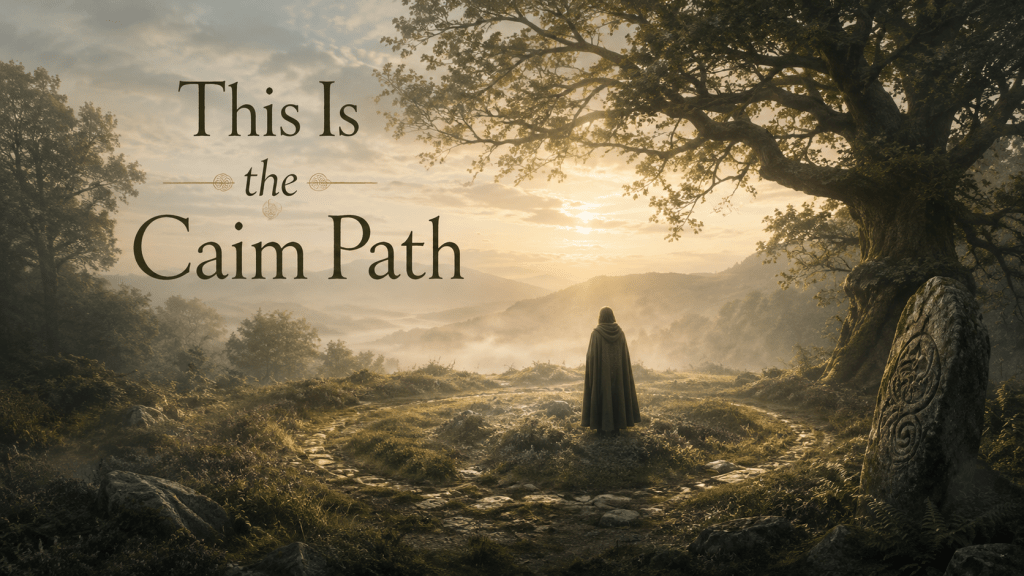
This Is the Caim Path
There comes a point, perhaps, when a spiritual path stops being something you follow and becomes something you live.
For many years I searched, studied, practised, explored and learned. I entered different traditions, listened to different teachers, worked with different systems and tried different ways of approaching the great questions that have followed human beings since we first looked towards the stars and wondered what any of this means.
And somewhere along the way, something changed.
I became less interested in finding the right system and more interested in the Mystery the systems were trying to describe.
That is where the Caim Path begins.
Caim is not another tradition asking to be believed. It is a way of approaching magic, mysticism and spiritual life through direct experience, relationship and transformation. At its heart is a simple recognition: the Mystery comes before the map.
Human beings have always created maps of the sacred. We have given names to gods, spirits, powers and invisible worlds. We have drawn diagrams, built temples, written prayers, created rituals and developed vast philosophical systems. Some of those maps are extraordinarily beautiful. Some are astonishingly sophisticated. Many have survived for centuries because they continue to speak to something deep within us.
But the map is never the landscape.
There is always something underneath it.
There is the moment of stillness beneath an old tree when the world suddenly seems more alive than it did a moment before. There is the strange sense of presence in a particular place, the change that occurs when a ritual suddenly becomes real rather than performed, or the unexpected knowing that arrives before the mind has had time to manufacture an explanation.
These experiences are older than the systems we use to interpret them.
The Caim Path begins there.
Rather than immediately asking what we are supposed to believe about an experience, it asks what actually happened. What changed in me? What did I notice? What did I encounter? What becomes possible if I resist the urge to name it too quickly?
There is a great freedom in not having to explain everything.
An experience may be psychological. It may be spiritual. It may be symbolic. It may arise from aspects of consciousness we barely understand, or perhaps from dimensions of reality for which we do not yet have adequate language. Caim does not demand that every mystery be solved before it is allowed to be meaningful.
Sometimes the wisest response is simply to remain curious.
This is why direct experience matters so much. Tradition still has enormous value. The spiritual and magical traditions of the world contain the observations, experiments, failures, insights and discoveries of countless people who came before us. They deserve to be listened to carefully.
But they are teachers, not masters.
We can learn from those who walked before us without having to walk precisely in their footprints.
The Caim Path also begins from a sense that the world is fundamentally relational.
Magic is sometimes portrayed as an attempt to impose the will of the magician upon reality, as though the magician stands on one side and the universe stands on the other waiting to be persuaded, controlled or commanded.
Caim approaches this differently.
We are already inside the thing we are attempting to influence.
We exist in relationship with land, place, memory, story, imagination, body, community and whatever invisible dimensions of life may surround and interpenetrate them. To practise magic, then, is not simply to command reality. It is to become consciously involved in a relationship that already exists.
This is one of the reasons the word Caim matters.
The old caim was an encircling prayer, a sacred boundary made around oneself while invoking protection and divine presence. Yet the circle can mean something more than protection alone. When I make a circle, I am not necessarily creating a sacred world inside an otherwise ordinary one. I am changing the way I stand within the world that is already here.
I stop. I become present. I pay attention.
And in that attention, relationship becomes possible.
Perhaps that is one of the oldest magical acts there is: to truly notice.
Attention changes experience. What we repeatedly notice becomes more available to consciousness. What we expect influences what we perceive. The meanings we give to events alter the way we live through them. The stories through which we understand ourselves quietly shape the lives we go on to create.
This is why consciousness itself must be understood as part of the magical instrument.
Imagination, expectation, emotion, bodily state, language and belief all affect the way we encounter reality. To recognise this is not to reduce magic to psychology. It is simply to acknowledge that consciousness is one of the places in which magic happens.
Imagination is especially important here.
Modern culture often uses the word imaginary to mean something unreal, but anyone who has worked seriously with ritual, prayer, meditation, creativity or inner transformation discovers very quickly that imagination is far more powerful than that.
Imagination is one of the ways possibility becomes experience.
Before something exists outwardly, it may first appear inwardly as image, intuition, feeling or idea. Through imagination we converse with symbol and story. We step into possibilities that have not yet become physical realities. We can encounter aspects of ourselves that ordinary thought cannot easily reach.
And sometimes imagination changes us.
Once we have changed, our relationship with the world changes too.
This brings us to what may be the central purpose of magic within the Caim Path.
Magic is transformation before it is power.
There is nothing wrong with practical magic. Human beings have always blessed homes, protected travellers, sought healing, divined possibilities, prayed for help and attempted to influence circumstances. Those things belong naturally to magical life.
But beneath them lies something deeper.
The magician changes.
A genuine magical path alters perception. It changes relationship. It changes the way we understand ourselves and the way we meet the world. The person who emerges from years of meaningful magical practice should not be precisely the same person who entered it.
The greatest magical work may therefore have far less to do with acquiring extraordinary powers than with becoming more fully alive. It is learning how to meet life with greater awareness, how to recognise when action is necessary and when it is wiser to allow, and how to stand before Mystery without immediately needing to reduce it to an explanation.
Ritual becomes especially interesting when seen from this perspective.
A ritual gathers the different parts of our experience into a coherent act. The body moves, words are spoken, symbols are encountered, imagination is engaged and attention becomes concentrated. Outer action and inner meaning begin to point in the same direction.
That is where ritual acquires its power.
Not necessarily because every inherited detail has been reproduced perfectly, but because the person, the symbol, the intention and the action have become aligned.
The candle matters because it means something.
The gesture matters because it carries intention.
The words matter because they direct awareness.
The place matters because relationship has been established with it.
When these things become coherent, ritual stops being theatre and becomes experience.
And experience can transform us.
There is, however, a temptation within occultism to assume that depth must always be accompanied by complexity. More symbols, more correspondences, more words, more diagrams and more secret knowledge can easily begin to feel like signs that we are progressing.
Sometimes they are useful.
But complexity is not the same thing as depth.
There comes a point when the path may become simpler rather than more complicated. We begin to listen more carefully. We notice patterns without immediately trying to control them. We learn that there are moments when intention is important and others when surrender is wiser. We discover that action and stillness both have their place.
Magic then becomes less about forcing reality and more about learning how to move within it.
There is an old impulse within magical traditions to speak of the magician mastering the forces of nature. The Caim Path is more interested in relationship than mastery. It asks whether real power might sometimes arise from understanding the movement already taking place and learning how to participate in it consciously.
That does not mean becoming passive.
It means learning the difference between action and struggle.
Perhaps that is where the circle brings us back again.
A circle has no true beginning and no true end. We enter it, encounter something, and emerge changed. Yet eventually we begin to realise that the world outside the circle was never truly outside at all.
The practice continues while walking through woodland, sitting quietly in a room, speaking with another person, watching rain against a window or standing beneath the night sky. It continues when life is beautiful and when life becomes difficult. The magical path gradually stops being something reserved for rituals, books and particular moments.
Magic becomes a way of seeing.
A way of attending.
A way of entering into relationship with life.
And perhaps, eventually, the distinction between magical practice and ordinary life begins to dissolve altogether.
That, for me, is the Caim Path.
It begins with presence. Presence opens relationship. Relationship makes participation possible. Participation transforms us.
And beyond all of that remains the Mystery itself, forever larger than the words we use to describe it.


Leave a Reply