One of the strange ironies of walking a magical path for long enough is that eventually you begin to realise how much modern spirituality encourages people not to question things.
Mention ancient mysteries, hidden wisdom, moon goddesses, sacred energies, lost Druid teachings, or cosmic feminine archetypes, and something peculiar often happens. People stop asking where the story came from. The more mystical the language sounds, the more likely it is to be accepted without challenge.
And that should concern us.
Not because spirituality is foolish. Not because myth is meaningless. Quite the opposite. Myth, symbol, ritual, and mystical experience are profoundly important. They shape the inner world. They shape identity, perception, and experience. They can transform lives.
But somewhere along the line, modern spirituality developed a habit of confusing interpretation with certainty. Repetition turns speculation into assumed truth, and once enough books, workshops, videos, and social posts repeat the same idea often enough, it begins to acquire an illusion of authority.
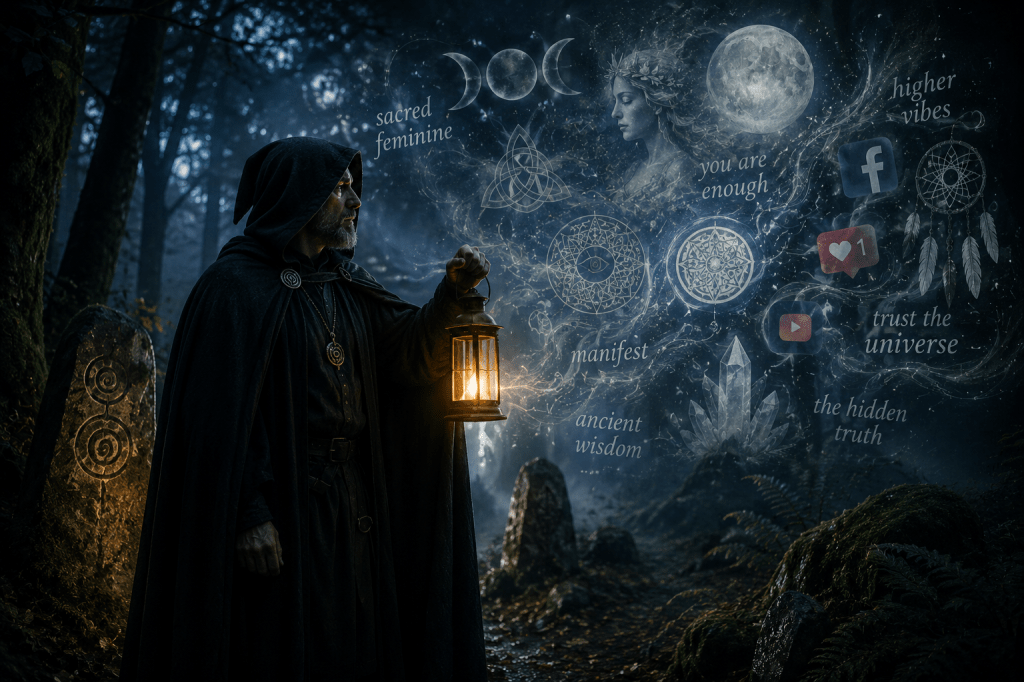
That illusion is glamour.
Not glamour in the modern sense of celebrity or fashion, but glamour in the older magical sense: enchantment, illusion, the shaping of perception so that something appears other than it truly is.
And once you begin noticing it, you see it everywhere.
Take mythic figures such as Arianrhod. Modern spirituality often presents her as a gentle lunar goddess — silver wheel, sacred feminine, cosmic mother, soft moonlit mysticism. Yet when you actually return to the source material in the The Mabinogion, a far more complicated figure emerges. She is difficult, reactive, sovereign, transformative through ordeal rather than comfort. She resists simplification.
That does not make modern spiritual experiences of her invalid. Personal experience matters. Symbolic relationships matter. Reconstruction has always existed in spiritual traditions. Human beings naturally reinterpret myths through the lens of their own age.
The problem begins when modern emotional interpretation is presented as unquestionable historical certainty.
Because then people stop exploring and start consuming.
The same thing happens with Cernunnos, though in the opposite direction. With Arianrhod, there is surviving mythology that gets softened and reshaped. With Cernunnos, there is remarkably little surviving information at all, yet modern pagan culture often speaks with enormous confidence about who and what he supposedly was. Over time, reconstruction becomes repetition, repetition becomes familiarity, and familiarity quietly transforms into assumed truth.
One author quotes another, who quotes another, who quotes somebody’s poetic reconstruction from fifty years ago, and eventually the entire thing gains the appearance of ancient authority.
Again, that is glamour.
And glamour becomes especially dangerous when it merges with identity.
Modern spirituality increasingly encourages people to collect identities rather than undergo transformation. Spiritual labels become accessories. Aesthetic mysticism replaces practice. People begin performing spirituality instead of living it. The image becomes more important than the work itself.
Yet genuine magical practice should move in the opposite direction.
Real magical work should make a person harder to hypnotise, not easier.
It should sharpen discernment. It should deepen awareness. It should make someone more conscious of symbolism, projection, emotional manipulation, suggestion, narrative, and psychological influence — not less conscious of them.
Instead, parts of modern spirituality seem to reward surrender. Surrender to fashionable interpretations, online personalities, spiritual tribalism, aesthetic identity, and emotionally comforting myths that require no real engagement beyond passive belief.
But mature practice rarely becomes more dogmatic. If anything, it becomes more comfortable with uncertainty. The deeper practitioners tend to be the ones willing to say, “This may be symbolic,” or “This may be reconstruction,” or simply, “I don’t know.”
That is not weakness.
That is discernment.
Because the deeper mysteries are rarely simplistic. The further you travel into mythology, mysticism, magic, psychology, and symbolic work, the stranger and more layered everything becomes. The world opens rather than closes.
And perhaps that is the real point.
Myths are not powerful because they provide easy answers. They are powerful because they continue speaking through the human imagination across centuries. They evolve. They adapt. They reveal new depths depending on who is engaging with them.
But to engage with them properly requires effort.
It requires reading deeply rather than accepting the first attractive explanation handed to you. It requires distinguishing between history, reconstruction, poetry, symbolism, intuition, and personal gnosis. It requires recognising when something is spiritually meaningful versus historically verifiable.
Most importantly, it requires awareness.
Awareness is the antidote to glamour.
The moment you stop automatically accepting the story, the spell weakens. The moment you begin asking questions, looking deeper, comparing interpretations, and examining where ideas actually came from, consciousness returns.
And that applies far beyond spirituality.
It applies politically. Socially. Psychologically. Culturally. Everywhere human beings shape reality through narrative and repetition.
Perhaps that is one of the deepest lessons magical practice can offer: not blind belief, but conscious engagement. Not passive enchantment, but awakened participation. Not the performance of mysticism, but the cultivation of awareness.
Because the real work was never about appearing mystical.
It was about becoming more conscious.
More honest.
More awake.
And in a world overflowing with glamour, that may be one of the most magical acts left to us.
Listen to Rob talking about this below.
 Ancient Whispers
Leave a comment