Imbolc no longer arrives for me with drama. It doesn’t break winter open or announce itself with clarity or warmth. It whispers. The land still looks asleep. Frost holds the ground, branches remain bare, and yet something has shifted. Not visibly. Not yet. But unmistakably. Over time, Imbolc has become the moment when what has survived within me matters more than what has ended.
I used to think of this point in the year as a beginning, or at least the promise of one. Now it feels different. It isn’t the green rush of spring or the abundance of summer that speaks to me here. It is something quieter and more exacting: the ember that did not die. The warmth that remained when everything else went cold. And once I began to notice that ember, I realised why Imbolc feels dangerous in the best possible way. Because it asks something of me that is hard to avoid once seen. It asks me to notice what is still alive in me, despite everything.
Fire has always been part of how I understand this season, but not as symbol or spectacle. Fire, here, is maintenance. It is the quiet, almost unremarkable act of tending what remains when hope has lost its glamour and certainty has thinned out. The flame I meet at Imbolc is not fuelled by future promises or imagined outcomes. It burns on memory, instinct, and something older than willpower. Over time, this has shifted how I understand change itself. For me, Imbolc is no longer about creating something new. It is about recognising what refused to leave. The habit I thought I’d lost. The calling that went quiet but never vanished. The part of me that endured the long night without applause.
I notice how the questions change at this point in the year. I find myself less interested in asking what I want, and more drawn to something subtler and more demanding: what kept me alive? What did I stay loyal to when there was nothing to be gained by doing so? That question lands differently. It strips away aspiration and leaves fidelity in its place.
The old associations of Imbolc with milk, lambing, nourishment, and protection used to feel almost quaint to me. Now they feel sharper. Milk, after all, is not abundance. It is just enough. It appears before the fields are green, before the world is generous again. It is sustenance without surplus, care without comfort. I recognise that pattern in myself. Imbolc is when care returns before confidence does. When I start tending my body, my nervous system, the inner places that have been braced for too long, without yet knowing what I’m preparing for.
I’ve learned to trust that this season reaches me through the body first. There is often a restlessness I can’t quite explain, a subtle agitation, an urge to clear space, simplify, reorder. Not as productivity, not as self-improvement, but as instinct. Something in me begins to make room. The body seems to know the season before my mind can name it.
Imbolc sits in an uncomfortable place for me, and I’ve come to respect that. It is no longer winter, but it is not yet spring. It offers no certainty, only orientation. There are no guarantees here. The cold can still return. The shoots may still fail. And yet I feel myself preparing anyway. I’ve come to see this as the courage of the ember. Not optimism. Not hope in outcomes. But a quiet loyalty to life itself. A willingness to tend what is alive without needing reassurance.
The changes I notice at this time are rarely visible to anyone else. They don’t announce themselves. They take the form of private decisions, subtle refusals, boundaries drawn inwardly rather than declared. The work, for me, is not to act but to align. To stand somewhere between what I have endured and what may yet come, and allow my inner compass to recalibrate.
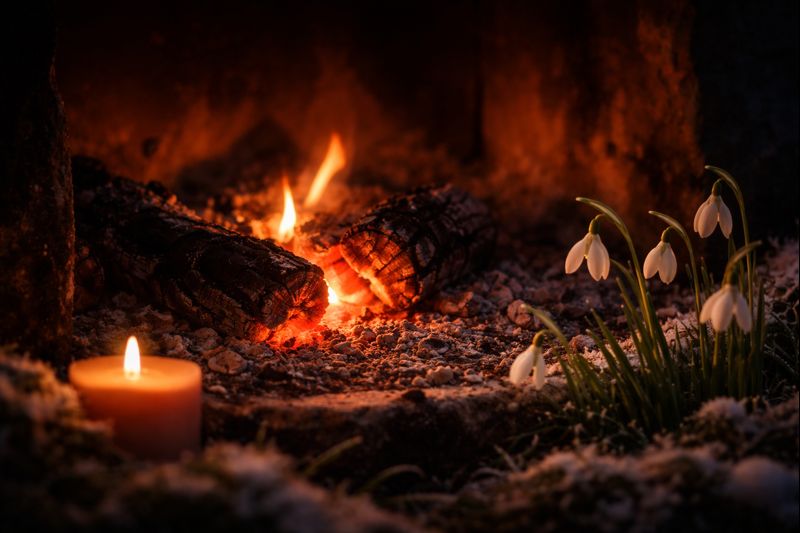
Fire, in this season, has stopped being metaphor for me. It behaves more like intelligence. It knows where to go. It responds to oxygen, to fuel, to space. Watching fire has taught me things I couldn’t have learned through effort alone. When I catch myself thinking I’ve lost my spark, I now recognise what is really happening. More often than not, the flame has been deliberately reduced. Banked. Protected. Made small enough to survive. Imbolc doesn’t ask me how to ignite passion. It asks me where I have closed down airflow to cope, where I have dampened my own heat to stay safe, where I have mistaken conservation for failure.
I’ve also come to appreciate the truth of small light. One candle is enough at Imbolc. Not as symbol, but as fact. Large lights attract attention; small lights change direction. A single flame alters a room. It shifts posture, breath, perception. It tells my nervous system that darkness is no longer absolute. I no longer hear this season asking me to shine. It asks me to stay lit. To choose continuity over intensity, steadiness over spectacle, to allow whatever is forming to mature below the surface where it can’t be interfered with.
Living Imbolc, for me, has nothing to do with reenactment or seasonal performance. It has become a posture. A quiet readiness. A patient tending. A reverence for what survived the cold. It is the refusal to abandon the ember simply because the fire is not yet impressive. And perhaps that is the deepest thing this season has taught me: that the most sacred work often happens before anyone can see it, including me. The light is returning. Not loudly. Not all at once. But faithfully. And, at this point in my life, that really is enough.


 Ancient Whispers
Leave a reply to Rob Chapman Cancel reply