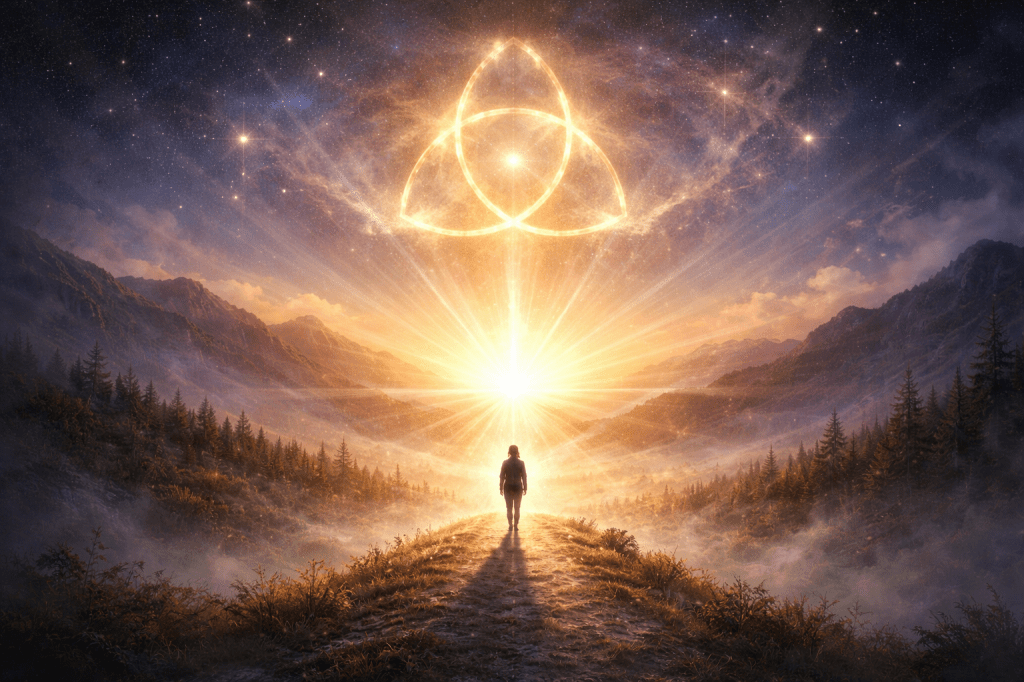
I have been sitting with a simple triad lately: one source, one truth, one point of liberty. The more I turn it over, the more it feels less like an idea to admire and more like a way of seeing life more clearly.
The first part is perhaps the easiest to say and the hardest to live from: there is one source. Call it God, the Tao, Spirit, the All, the great mystery, or leave it unnamed altogether. The label matters less than the recognition that everything arises from something deeper, wider, and more incomprehensible than our minds can comfortably hold. We spend a great deal of time trying to bridge the gap between ourselves and the divine, yet the deeper truth may be that there is no gap to bridge. We are already within it. We always were.
That is both comforting and mildly irritating, because the ego quite likes the idea of a heroic journey toward enlightenment. It likes the notion that one day, after enough effort and enough impressive spiritual experiences, it will finally arrive. But if we are already part of the whole, then much of what we call seeking is not really about arriving anywhere. It is about noticing what has always been true beneath the noise.
This is one of the reasons I have always had a soft spot for the older, earthier strands of spirituality, including early Celtic Christian thought. There is something sane in the idea that the sacred is not locked away in some distant heaven, but present in land, weather, breath, song, silence, work, and word. Not somewhere else. Here. Not after some great attainment. Now. The divine is not absent. We are the ones who keep wandering off into abstraction.
That leads to the second part of the triad: one truth.
Not one truth in the sense of a slogan, a doctrine, or a tribe declaring it has exclusive access to reality. I mean truth in the simpler, harder sense: what is actually there when illusion is stripped away. Reality before preference. Reality before fantasy. Reality before the stories we tell ourselves in order to feel safe, superior, special, or absolved.
Most of us live far more from interpretation than from reality. We mistake habit for truth, opinion for truth, conditioning for truth, fear for truth, and desire for truth. We inherit ways of seeing from family, culture, religion, school, heartbreak, pride, shame, and all the little moments that tell us who we think we are. Then we defend those stories as if they were the world itself.
But they are not the world. They are only our arrangement of it.
You can see this plainly whenever someone is completely out of step with what is real. Think of those painful moments on talent shows when someone walks on stage utterly convinced they are astonishing, because everyone around them has fed the illusion, and then opens their mouth and the reality is very different. It is funny until it becomes sad. Not because they cannot sing, but because they have been living inside a false picture, and reality eventually breaks it open.
That is not just television. That is all of us, in one area of life or another.
Much of what we call suffering is misalignment. We are pushing against what is, while trying to force what is not. We cling to a self-image, a plan, a role, or a desire long after reality has started whispering, rather patiently, that this is not it. And because we do not want to hear it, life gets louder.
I know this pattern well enough in my own life. There have been times when I pushed hard toward a version of myself that, on paper, made sense but in practice was never quite true. I could work at it, argue for it, train for it, build around it, even persuade myself it was what I wanted. But if it was out of alignment with reality, it never flowed. There was always friction. Always effort without life in it. Only when I stepped back and admitted that something was not actually mine did other doors begin to open.
That is why truth matters. Not as an abstract virtue, but because truth is what allows movement. When I see clearly, I can act clearly. If I am honest about where I am, what I am, what I can do, what I cannot do, what I want, and what I do not want, then action becomes clean. Perhaps not easy, but clean.
And that brings us to the third part of the triad: one point of liberty.
I do not think liberty here means the freedom to do whatever we fancy. That usually turns out to be another kind of bondage. I think it points instead to a kind of inner position — a place of balance from which real movement becomes possible.
Not passivity. Not resignation. Not sitting with folded hands saying, “Well, this is reality, so I shall do nothing.” Quite the opposite. It is the point at which we stop wasting energy fighting what is true, and begin acting from it. The point at which we come back into alignment with life, and from that alignment something opens.
There is a living stillness in that. A centre. A place where you are no longer divided against yourself. From there, one clean step can change everything.
That, to me, is liberty. Not the freedom of fantasy, but the freedom that comes when illusion loosens its grip. When you stop insisting on being who you are not. When you stop trying to force life into shapes that do not belong to you. When you stop arguing with the current and begin moving with it.
Real magic begins there.
Not in trying to become something grandiose. Not in inflating yourself into a god. Not in pretending you are limitless when clearly you are not. We are not the whole. We are part of the whole. That is smaller than the ego wants and far greater than the ego can bear. There is humility in it, but also relief. You do not have to carry the universe. You only have to stop pretending you are separate from it.
So perhaps the work is simpler than we make it.
Return to the source.
Notice the truth.
Stand in the point of balance.
Then take the next honest step.
That may be the only act of magic you need.
You can hear Rob Talk about this on the Saturday Grove
 Ancient Whispers
Leave a comment