Most people come to magic because they want power.
More influence.
More control.
More ability to shape events.
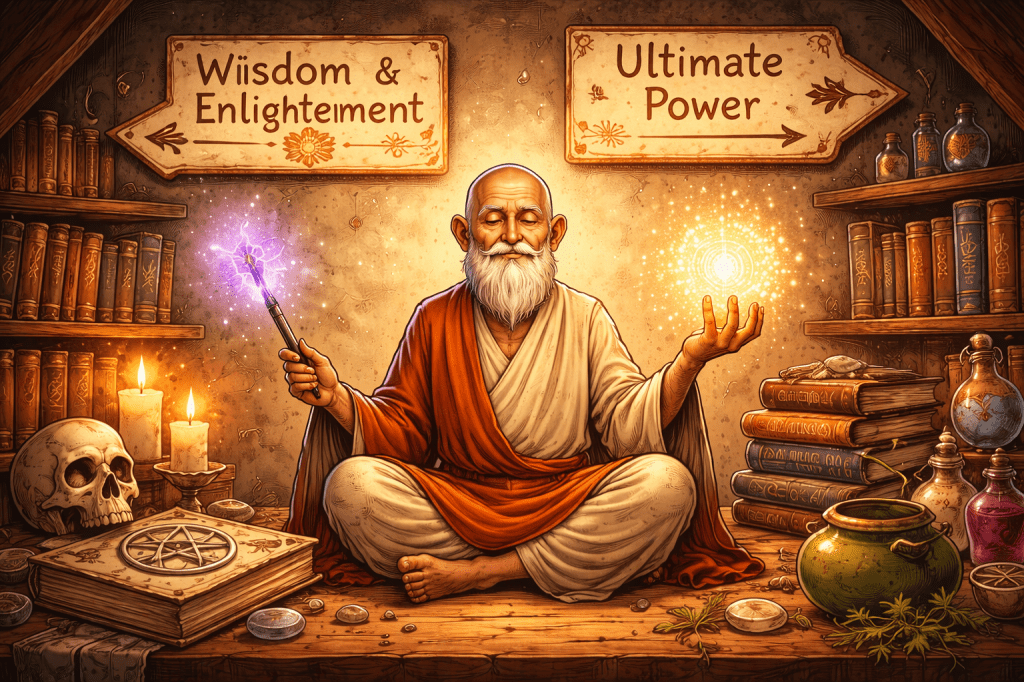
And yet one of the strangest things about the magical path is this: the people who chase power directly are often the ones who struggle the most to find it.
One of the things that quietly runs through the history of magic is the question of power.
Not just power in the theatrical sense — lightning bolts and dramatic manifestations — but influence. The ability to shape events, alter circumstances, and move the currents of life in a deliberate way. That is, after all, what many people think they are looking for when they first step onto a magical path.
Power.
And yet if you spend any real time studying the lives of practitioners, something curious appears. The people who obsessively pursue magical power often seem to struggle the most with it.
They accumulate rituals.
They memorise correspondences.
They hunt for stronger techniques, deeper initiations, more advanced systems.
And still they feel as though something is missing.
At the same time, there are other figures scattered throughout the same traditions who appear to possess a quiet authority. They rarely speak about power directly. In fact, they often seem uninterested in it. They pursue understanding, discipline, clarity, and wisdom. And yet when you look closely at their lives, they appear to influence the world around them in ways that are unmistakable.
This contrast is not accidental.
The pursuit of power begins from a particular assumption — the assumption that power is something you lack.
When you approach magic from that place, every action subtly reinforces the same belief. You perform rituals to gain power. You study systems to acquire power. You attempt workings in order to obtain power. Underneath it all sits the quiet premise that power exists somewhere outside you and must be seized or accumulated.
That premise becomes the invisible limitation.
The older traditions were often more subtle about this. They placed the emphasis somewhere else entirely. Instead of seeking power, they encouraged the practitioner to seek alignment, understanding, and self-transformation. The assumption was that when the practitioner changes, their relationship with reality changes as well.
Magic begins to move differently from that place.
You can see this pattern in the lives of many figures who walked unusual paths. One example that came to mind recently while reading was Allan Bennett — an early associate of Aleister Crowley who later became a Buddhist monk. Bennett had been deeply involved in the Western occult revival of the late nineteenth century, exploring ceremonial magic with the seriousness that characterised that period.
And yet his journey eventually led him somewhere quieter.
Rather than pursuing magical power as an end in itself, he turned toward spiritual discipline and awakening. He sought understanding. He sought liberation from illusion. By the time he was teaching Buddhism in the East, the language of power had almost disappeared from his work entirely.
That does not mean the magical current had vanished. If anything, the opposite seems true.
Those who encountered such individuals often describe a kind of presence about them — a clarity, a steadiness, a subtle influence that does not need to announce itself. It is not the performance of power. It is the natural consequence of alignment.
Something similar can be seen in many contemplative traditions. The Taoist sage does not chase power. They cultivate harmony with the flow of the Tao. The yogi does not begin by seeking supernatural abilities; they refine awareness and discipline the mind. Even in Western magical systems, the deeper teachings often emphasise purification, balance, and self-knowledge before any attempt to influence the outer world.
The reasoning behind this is simple once you see it.
If you pursue power directly, your attention is always fixed on the result. You are measuring yourself against outcomes. Did the working succeed? Did the manifestation appear? Am I more powerful now than I was before?
That mindset creates tension. It creates grasping. And grasping distorts perception.
But when you pursue understanding instead — when you cultivate awareness, discipline, and honesty with yourself — the relationship changes. You begin to see the patterns of reality more clearly. Your reactions soften. Your timing improves. Your actions become more precise because they are no longer driven by desperation.
From the outside it may look as though you have become more powerful.
From the inside it feels more like clarity.
This is one of the quiet paradoxes at the heart of magical work. Power is often the by-product of transformation rather than the goal of it. The practitioner who becomes aligned, attentive, and internally coherent inevitably begins to affect their environment differently. Not because they have forced reality to obey them, but because they are no longer fighting the currents they are trying to move within.
It is a subtle shift, but it changes everything.
When magic is approached as a tool for accumulating power, frustration is almost inevitable. When it is approached as a path toward understanding — understanding oneself, understanding reality, understanding the patterns that connect them — the practice deepens in a different way.
And then something interesting happens.
The magic that once seemed distant begins to appear in ordinary life.
Not as spectacle.
But as influence, timing, intuition, and the quiet sense that you are moving with the pattern rather than against it.
In other words, the pursuit of wisdom reveals that the power you were looking for was never absent in the first place. It was simply waiting for you to become the kind of person who could recognise it.
 Ancient Whispers
Leave a comment