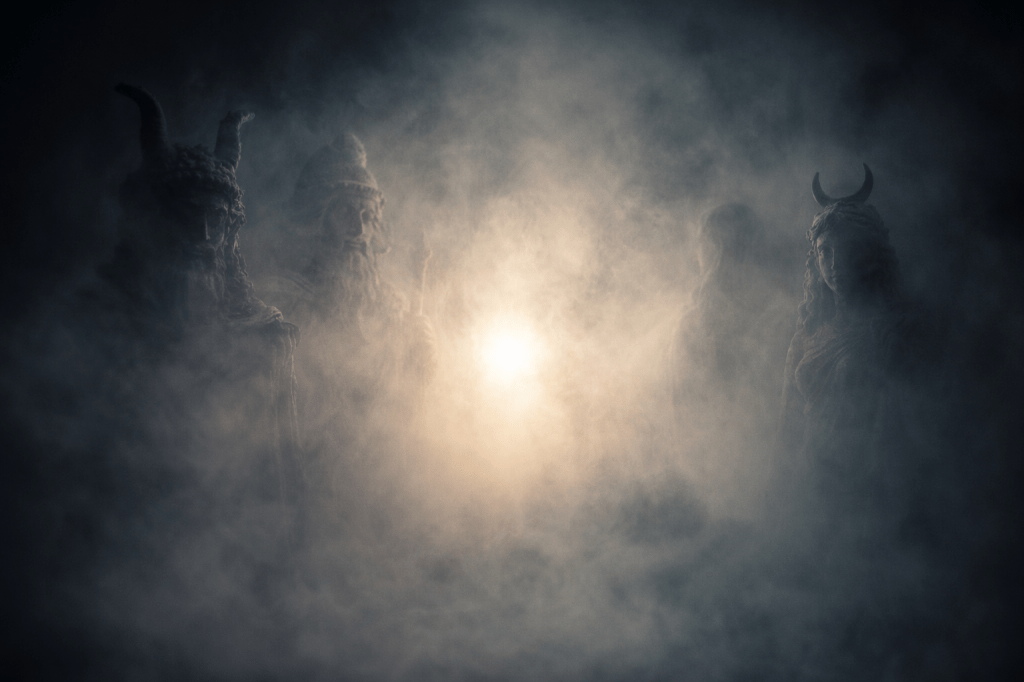
This is something that has become clear to me slowly, not as a conclusion but as a loosening. Gods, as I have known them, are not the source. They are not where things begin. They are not what sustains the depth when everything else falls quiet. They arise later, naturally, almost inevitably, as names do, as shapes do, as the mind reaches for something to hold what has already been encountered.
I did not arrive at this through argument or rejection. There was no moment of disbelief or rupture. It came through attention. Through noticing the difference between the moment something is experienced and the moment it is named. The experience is immediate, unguarded, without edges. The name comes after, as a way of speaking, a way of pointing, a way of sharing what cannot be passed hand to hand. The trouble begins only when the name is mistaken for the thing itself.
I have watched how easily forms gather. A feeling deepens. A presence is sensed. A current moves through the body or the land or the quiet between thoughts. And almost immediately, something reaches to clothe it. A story. An image. A god-name. This is not wrong. It is human. Forms arise the way frost forms on a window, or the way a melody gathers around silence. They are responses, not errors.
But forms have weight. Names settle. Images harden. What was once a doorway becomes a dwelling. What once pointed begins to claim territory. Over time, attention shifts. Instead of resting in the depth itself, it circles the form that once emerged from it. The god becomes something to approach, appease, defend, or explain. And quietly, almost without anyone noticing, the source is stepped away from.
What I have come to trust is that the depth does not mind this. It does not compete with its own expressions. It does not withdraw when misnamed or misunderstood. It does not require correction. The current continues to flow whether it is called this or that, whether it is wrapped in story or left bare. The source does not depend on accuracy. It only asks for attention.
There is a difference, I have found, between pointing and containing. A god-name can point beautifully. It can orient the heart, focus the imagination, give language to devotion or wonder. But when the pointing finger is treated as the destination, something subtle is lost. The living immediacy is replaced with reference. Experience becomes belief. Relationship becomes structure.
Direct experience always comes first. Before theology. Before myth. Before explanation. There is a moment — often brief, often quiet — where something is simply encountered. No demand is made of it. No claim is laid upon it. It is known in the body, in the breath, in the way the world feels suddenly more itself. Later, the mind tries to say something about it. That saying is not the problem. Forgetting what came first is.
This is why I no longer feel the need to defend gods or tear them down. They are not fragile, and neither is what gives rise to them. Forms do not need to be collapsed for the depth to be known. Belief does not need to be corrected. Even confusion does not block the current for long. The source is not offended by misunderstanding. It waits, patient and unhurried, beneath every name.
What has shifted for me is where I place my attention. Less on the image. Less on the language. More on the place from which both arise. When that happens, something settles. The urgency to define fades. The need to explain relaxes. What remains is simple and difficult to speak about without immediately reaching for metaphor again.
And so I notice. I notice when a name is useful and when it has begun to obscure. I notice when devotion feels alive and when it has drifted into habit. I notice that the deepest moments are often the least describable, and that whatever I say about them afterwards is always already late.
Gods are not the source. They are gestures toward it. Beautiful ones, sometimes necessary ones, but never the thing itself. The source does not require belief, defence, or destruction. It does not need to be rescued from form or frozen into one. It remains, quietly available, beneath every word that has ever tried to hold it.
 Ancient Whispers
Leave a comment