There are moments in life when something begins to move within us before we have words for it. A quiet restlessness. A sense that the old way of being no longer quite fits. A tug toward something we cannot yet name. These moments often arrive softly, almost imperceptibly, yet they carry the power to reshape a life.
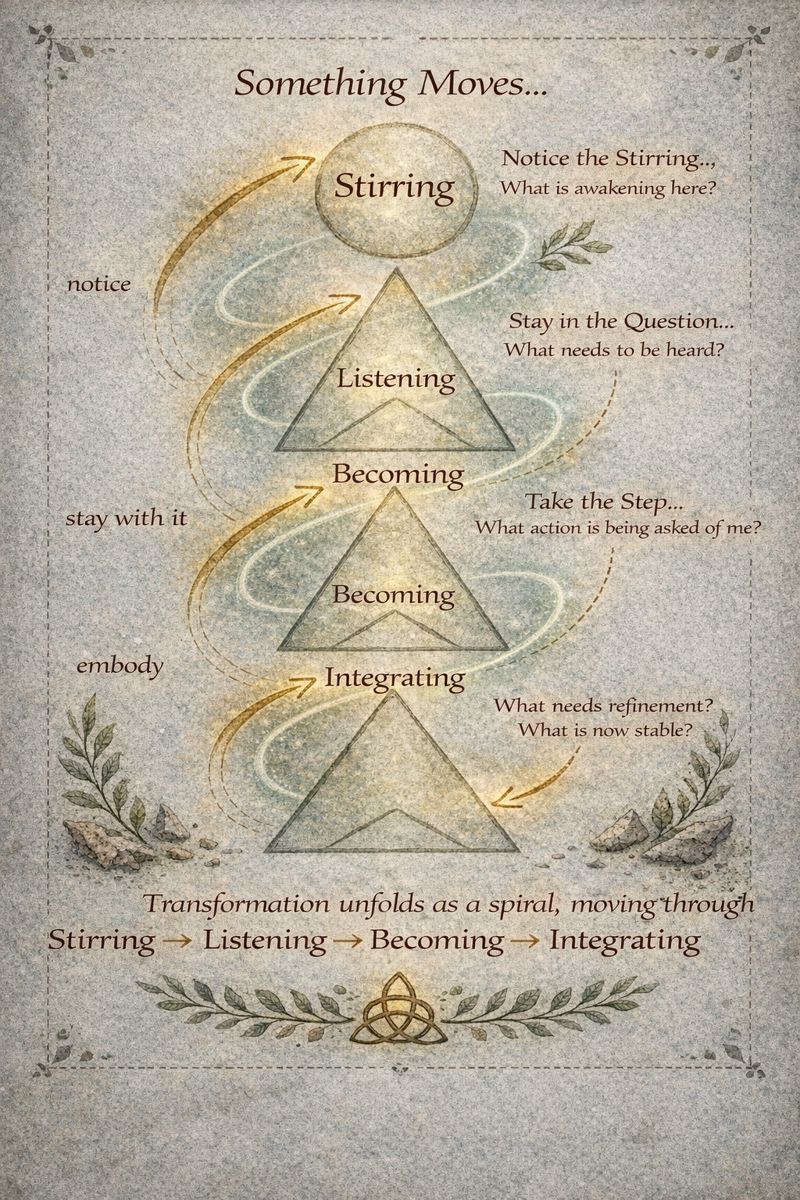
The diagram before us is not a map in the sense of directions or destinations. It does not tell us where we should go, nor does it prescribe what we must become. Instead, it reflects a rhythm — a repeating movement through which change naturally unfolds. A cycle not imposed from the outside, but arising from the deep intelligence of life itself.
This rhythm can be named simply:
Stirring → Listening → Becoming → Integrating
And then, inevitably, back to Stirring again.
It is not a ladder of progress.
It is a spiral of formation.
Stirring: When Something Begins to Move
Every genuine change begins not with decision, but with disturbance.
Stirring is the moment when something inside us is touched. It may come as longing, dissatisfaction, curiosity, grief, or wonder. Sometimes it arrives as crisis; sometimes as quiet attraction. It does not always feel spiritual. Often it feels inconvenient, unsettling, even irritating.
Yet stirring is not random. It is the soul’s way of signalling that growth is already underway.
At this stage, we are not yet being asked to act. We are being asked to notice.
Stirring is subtle. It can be ignored, suppressed, or distracted away. In a world that values productivity and certainty, we are often tempted to resolve discomfort quickly — to label it, explain it, or eliminate it. But stirring does not want resolution. It wants attention.
This is the stage where questions arise:
- Why does this keep returning to my thoughts?
- Why does this matter to me more than I expected?
- Why does this no longer feel enough?
These are not problems to solve. They are signals that something deeper is beginning to form.
Stirring is the seed breaking open underground. Nothing visible has changed yet, but everything is already different.
Listening: Staying With What Is Arising
If stirring is the awakening of movement, listening is the willingness to remain present with that movement rather than rushing ahead of it.
Listening is not passive. It is not waiting for answers to drop from the sky. It is an active posture of attention — turning toward what is unfolding instead of turning away from it.
This stage can feel uncomfortable, because it resists premature certainty. We may want clarity, direction, assurance. But listening often provides none of these immediately. Instead, it invites us to stay close to the question itself.
In listening, we begin to sense the texture of what is emerging:
- Is this fear or invitation?
- Is this desire or avoidance?
- Is this grief asking to be honoured, or change asking to be welcomed?
Listening takes time. It is slow by nature, and modern culture is not kind to slowness. We are taught to decide, declare, and move on. Yet deep transformation does not respond well to force. It responds to presence.
In listening, we may find ourselves drawn to silence, to solitude, to prayer, to walking, to journaling, to conversations that feel unusually meaningful. These are not techniques; they are ways of making space for something that does not yet have form.
This is often the most fragile part of the cycle. Many stirrings die here, not because they were false, but because they were not given enough room to breathe.
Listening is the courage to remain open when nothing is settled yet.
Becoming: When the Inner Begins to Take Form
At some point, listening gives way to movement.
Becoming is the stage where what was sensed inwardly begins to express itself outwardly. This is where insight turns into action, where longing becomes choice, where values begin to reshape behaviour.
Becoming is rarely dramatic. It often arrives through small decisions:
- Saying yes when you would once have said no.
- Letting go of something that once defined you.
- Beginning a practice you never thought you would try.
- Speaking truth where you once remained silent.
This stage can feel exhilarating — but it can also feel disorienting. Identity begins to shift. Familiar roles loosen. Certainty gives way to experimentation.
Becoming is not about perfect execution. It is about alignment in motion. We try, adjust, retreat, return. We discover that growth is not linear but responsive, shaped by feedback and lived experience.
Here, the inner life and the outer life begin to converse.
What was once only felt becomes enacted. What was once only imagined begins to shape reality.
This stage often exposes vulnerability. When we act on what matters, we become visible — to ourselves and to others. There is risk in becoming. But without risk, transformation remains theoretical.
Becoming is the moment when potential chooses incarnation.
Integrating: When Change Becomes Part of Who We Are
Not all change transforms us. Some experiences remain isolated episodes. Integration is what allows growth to become part of our identity rather than a temporary phase.
In integration, what we have lived settles into us. Lessons deepen. Patterns stabilise. We no longer need to consciously maintain what once required effort.
This is the stage of embodiment.
Integration does not mean perfection. It means coherence. The new way of being begins to feel natural, not forced. We stop performing change and start inhabiting it.
This stage often feels quieter than Becoming. Less dramatic. More grounded. And because it lacks intensity, it is sometimes undervalued. Yet integration is where maturity forms.
Here we learn:
- Which changes were true and which were experiments.
- What must be refined.
- What can now be trusted.
Integration also includes grief. Not every becoming is kept. Some paths are honoured and released. Integration teaches discernment — not everything that stirred was meant to stay.
But what does remain becomes stable ground.
And from that ground, eventually, a new stirring will arise.
The Spiral, Not the Circle
Although the process repeats, it does not return us to the same place.
Each cycle unfolds at a deeper level of understanding, greater honesty, or wider capacity. The same questions may reappear, but we meet them differently. What once shook us now invites us. What once confused us now instructs us.
This is why the diagram is best seen not as a closed loop but as a spiral.
We are not stuck in repetition. We are being shaped through rhythm.
Growth is not escape from cycles; it is participation in them with increasing awareness.
Why This Pattern Appears Across Traditions
This rhythm appears in countless spiritual, psychological, and artistic traditions because it reflects how human consciousness actually changes.
In therapy, it shows up as:
- awareness
- reflection
- behavioural experimentation
- consolidation
In contemplative spirituality, it appears as:
- awakening
- discernment
- practice
- embodiment
In creative work, it unfolds as:
- inspiration
- incubation
- expression
- refinement
Different languages, same movement.
What changes is not the process, but how gently or violently we allow it to work on us.
When we resist stirring, we stagnate.
When we rush listening, we make shallow choices.
When we avoid becoming, we remain unfulfilled.
When we skip integration, we burn out.
Honouring the whole rhythm protects us from spiritual bypassing, from impulsive reinvention, and from remaining trapped in preparation without action.
It allows transformation to be both alive and sustainable.
Discomfort as Teacher, Not Obstacle
One of the most important truths this pattern reveals is that discomfort is not a sign of failure — it is often a sign of movement.
Stirring rarely feels calm. Listening often feels uncertain. Becoming often feels risky. Even integrating can feel strange, as old identities loosen.
But discomfort is not the enemy of growth. It is often the evidence that something honest is taking place.
The danger is not discomfort. The danger is avoidance.
When we only seek safety, we often remain unchanged. When we remain open to being shaped, we discover capacities we did not know we possessed.
This does not mean chasing suffering or seeking crisis. It means being willing to stay present when life begins to rearrange us.
A Path of Formation, Not Achievement
Perhaps the most radical implication of this pattern is that transformation is not an achievement to be accomplished, but a formation to be received.
We do not manufacture becoming.
We participate in it.
Our role is not control, but cooperation.
This perspective shifts spiritual life from performance to relationship — relationship with what is unfolding, with what is calling, with what is asking to be lived.
We are not constructing ourselves from scratch. We are being shaped by something deeper than conscious planning.
This is why humility, patience, and trust are not sentimental virtues, but practical necessities for growth.
They keep us aligned with the process rather than forcing outcomes.
Living the Pattern in Everyday Life
This rhythm is not reserved for dramatic life changes. It unfolds continuously in ordinary moments:
- In conversations that change how we see someone.
- In habits that quietly shift over time.
- In small acts of courage repeated until they become character.
Each day offers countless micro-cycles of stirring, listening, becoming, and integrating.
When we learn to recognise the pattern, we stop demanding instant clarity and start respecting gradual formation.
We learn to ask better questions:
- What is stirring right now?
- What needs listening rather than fixing?
- What small step is trying to take shape?
- What has already integrated that I have not yet acknowledged?
These questions cultivate wisdom without forcing certainty.
The Quiet Courage of Staying in the Process
There is a particular courage in allowing oneself to be formed rather than reinvented.
Reinvention promises control. Formation requires surrender.
Yet formation produces depth, not just novelty.
Those who remain faithful to the slow work of becoming often discover that what emerges is not a new persona, but a truer expression of what was always waiting to be lived.
The pattern does not lead us away from ourselves. It leads us more fully into ourselves — and through that, more fully into the world.
In Closing: Trust the Rhythm
The diagram does not demand belief. It invites recognition.
Most people can look back on their lives and see this rhythm already at work:
Moments that began as vague unease.
Periods of questioning.
Steps taken without full certainty.
New ways of being that now feel natural.
The work, then, is not to create the process, but to trust it.
To allow stirring to speak.
To give listening its time.
To step into becoming when it arrives.
And to honour integration when growth settles into quiet strength.
And when the next stirring comes — as it always will — to recognise it not as disruption, but as invitation.
Because becoming is not something we finish.
It is something we live.
 Ancient Whispers
Leave a comment