Ceridwen is today almost universally described as a Welsh goddess of inspiration, rebirth, and transformation. This description appears so frequently in modern books, websites, and spiritual discourse that it has acquired the weight of assumed antiquity. Yet when the claim is examined against the surviving Welsh sources and the history of its transmission, it becomes clear that the identification of Ceridwen as a goddess is not ancient at all, but a modern construction—one shaped largely by twentieth-century myth-making rather than medieval tradition.
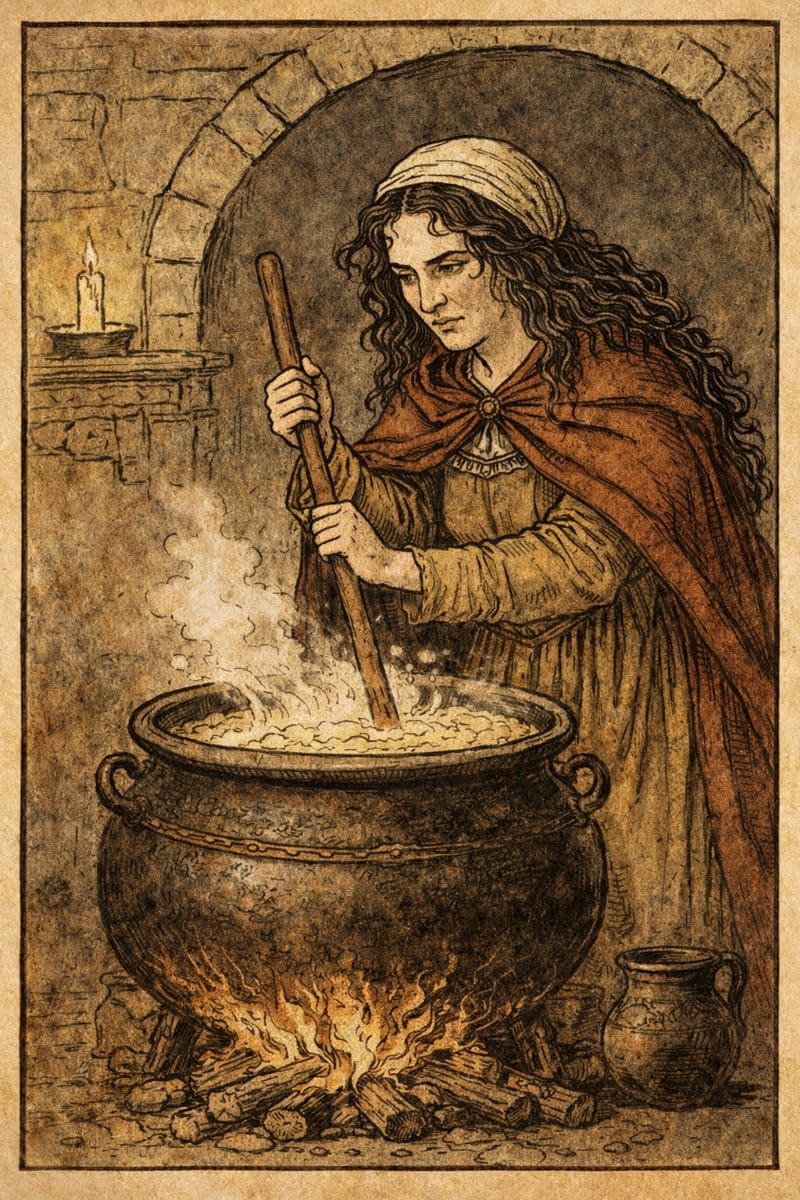
Ceridwen’s primary appearance in Welsh literature is in Hanes Taliesin (The Tale of Taliesin), preserved in manuscripts from the sixteenth century but drawing on earlier medieval material, most likely no earlier than the ninth century. In this narrative, Ceridwen is presented as a powerful enchantress, a figure of magic and transformation, and the keeper of a cauldron whose brew grants poetic inspiration, or awen. She is formidable, dangerous, intelligent, and decisive. What matters, however, is not only what the text says, but what it does not say. At no point is Ceridwen explicitly described as a goddess. She is not placed within a pantheon, she is not shown receiving worship, and there is no suggestion of cult, shrine, or ritual devotion attached to her. She exists firmly within the mythic-literary world of medieval Welsh storytelling, where sorcerers, poets, and liminal figures move between worlds without necessarily being divine.
This distinction is important because medieval Welsh literature does not preserve a clear record of pre-Christian religion in the way that, for example, Norse myth preserves named gods with defined cults. The Welsh material is fragmentary, poetic, and heavily shaped by Christian transmission. As historians of religion have repeatedly noted, it preserves stories, not theology. The absence of evidence for Ceridwen as a goddess is therefore not a gap waiting to be filled, but a boundary that must be respected. There is no archaeological evidence, no Roman or early medieval testimony, and no liturgical or devotional material that suggests Ceridwen was ever worshipped as a deity in ancient Wales.
The modern idea of “Ceridwen the goddess” emerges much later, most decisively in the twentieth century, and its roots can be traced with some precision. The single most influential figure in this development is Robert Graves. In his 1948 book The White Goddess, Graves proposed the existence of an ancient, pan-European Triple Goddess who, he believed, lay behind all true poetry and myth. Within this highly imaginative framework, Ceridwen was reinterpreted as a divine figure: a goddess of inspiration, transformation, and rebirth, aligned with Graves’ broader poetic vision of mythic history.
This reinterpretation proved enormously influential, particularly within modern paganism, goddess spirituality, and popular Celtic mythology. However, influence is not evidence, and Graves’ mythological system has been thoroughly discredited within academic scholarship. This is not a matter of scholarly disagreement or ongoing debate; it is a settled conclusion within the fields of history, folklore, and Celtic studies. Graves’ method involved treating poetic metaphor as historical fact, collapsing material from vastly different cultures and time periods into a single narrative, and relying on intuition and symbolic resonance rather than linguistic, archaeological, or textual evidence. These approaches are not accepted as valid historical methodology.
The critique of Graves’ work is clearly articulated by historians such as Ronald Hutton, particularly in The Pagan Religions of the Ancient British Isles and The Triumph of the Moon. Hutton demonstrates that many figures now described as “Celtic goddesses” were never deities in the historical sources and that the idea of a surviving ancient goddess cult underpinning European myth is unsupported by evidence. In this scholarly context, Graves’ Ceridwen is understood not as a recovery of ancient belief, but as a modern mythic creation—powerful, poetic, and imaginative, but historically unfounded.
This distinction matters because the modern portrayal of Ceridwen as a goddess is often presented as if it were ancient fact rather than modern interpretation. To say that Ceridwen functions as a goddess within contemporary spiritual practice is a legitimate personal or religious statement. To claim that she was historically worshipped as a goddess in ancient Wales is a factual claim, and one that cannot be supported by the available evidence. Confusing these two does a disservice both to historical scholarship and to modern spirituality, which does not require false antiquity to be meaningful.
Historically speaking, Ceridwen is best understood as a mythic enchantress and a literary figure embodying transformation, initiation, and poetic inspiration. Her power lies in story, in symbolism, and in the liminal space she occupies between knowledge and danger, loss and rebirth. She does not need to be elevated into a reconstructed pantheon to remain compelling. Indeed, recognising her as a figure of medieval myth rather than an ancient goddess allows her to be seen more clearly, not less.
Ceridwen’s endurance is not the result of forgotten temples or suppressed cults, but of narrative power. She survives because her story speaks to transformation and cost, not because she was once worshipped. Stripped of modern projections, what remains is not diminished.
It is simply honest.
 Ancient Whispers
Leave a comment