As the winter solstice approaches, the world seems to pause. Days shorten, light thins, and growth retreats beneath the surface. Modern life does its best to ignore this, surrounding us with artificial brightness and insisting that nothing really changes. But the body knows better. The land knows better. And so do the old stories.
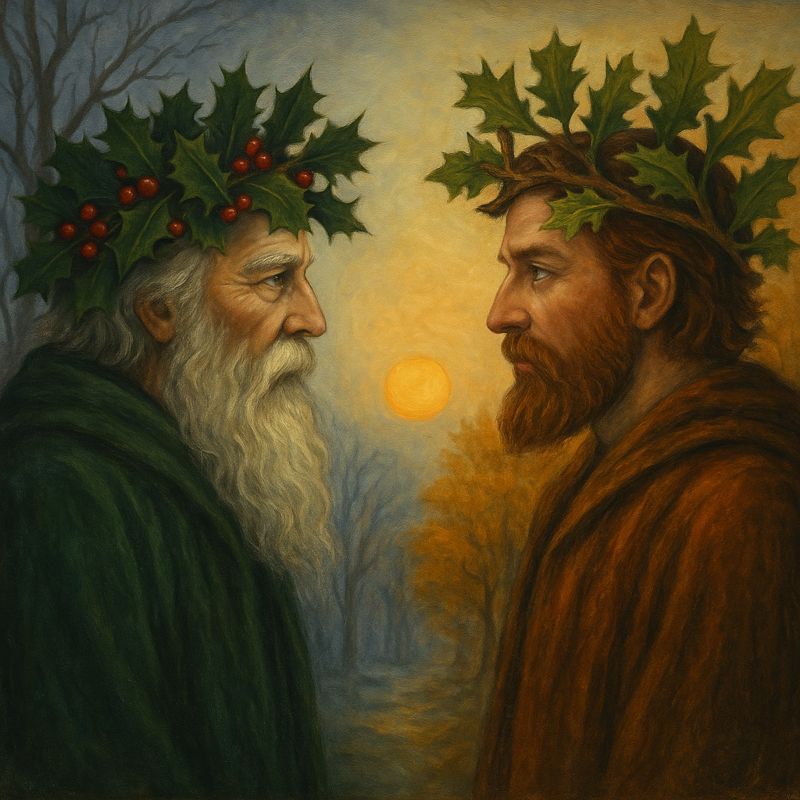
One of those stories is the tale of the Holly King and the Oak King. It’s often presented as a simple seasonal myth: two figures locked in an eternal cycle of combat, one ruling the dark half of the year, the other the light. The Oak King governs the waxing year, from winter solstice to summer solstice. The Holly King rules the waning year, from summer solstice back to winter. At each turning point, sovereignty passes.
Taken literally, it’s folklore. Taken symbolically, it’s something much more useful.
What this story really describes is not a battle, but a rhythm. Not victory and defeat, but succession. Each king reigns only for as long as his qualities are needed.
The Oak King represents outward growth, expansion, strength, visibility. He rules the season of building, striving, becoming more. This is the energy most modern cultures are comfortable with. It looks like productivity, ambition, confidence, achievement. We understand it. We reward it.
The Holly King, by contrast, rules contraction. He governs withdrawal, introspection, endurance, and restraint. His season is not about adding, but about holding. Not about becoming more, but about becoming quieter, leaner, more essential.
And this is where the wisdom often gets lost.
The Holly King is not the villain of the story. He is not the failure phase, or the necessary evil before things get “better” again. He represents a mode of being that is vital, corrective, and deeply intelligent. Without him, the cycle collapses. Growth without contraction becomes exhaustion. Expansion without retreat becomes brittle.
The solstice marks the moment when the Holly King reaches the height of his power — not because darkness has won, but because it has done its work. The land has rested. Seeds have waited. Energy has been conserved. Only then can the turn begin.
This matters far beyond seasonal symbolism.
Most people try to live permanently under the Oak King. They push through tiredness, override instinct, and treat rest as something to earn rather than something to honour. When life forces a period of withdrawal — illness, loss, uncertainty, a sense of being “between” things — it’s often interpreted as a personal failure.
The old story suggests otherwise.
There are times when the most appropriate response to life is not action, but patience. Not assertion, but attention. Not growth, but consolidation. The Holly King doesn’t demand that you stop existing. He asks that you stop forcing.
The winter solstice, then, is not a celebration of immediate renewal. It’s a recognition that renewal has become possible again. The light does not rush back in. It returns slowly, almost imperceptibly. The first shift is subtle enough to miss unless you’re paying attention.
That subtlety is part of the teaching.
Real change rarely announces itself. It begins as a quiet easing, a slight increase in capacity, a sense that something is turning even though nothing obvious has happened yet. The Oak King does not burst onto the scene in triumph. He inherits a world that has been prepared for him by stillness.
Looked at this way, the Holly and Oak are not external figures but internal movements. Most of us pass between them many times in a single life, sometimes in a single year. There are seasons when outward effort makes sense, and seasons when it doesn’t. Wisdom lies not in choosing one king over the other, but in recognising who is currently in rightful rule.
The solstice invites an honest question: what has been stripped back in you this year, and what has that made room for? What have you been asked to release, not because it was wrong, but because its season has ended?
If the Holly King is present in your life right now, he isn’t asking you to give up. He’s asking you to endure wisely. To tend what still has life. To trust that not everything needs to be visible to be growing.
And when the Oak King returns, as he always does, he doesn’t come to overthrow the dark. He comes because the dark has finished its work.
That, perhaps, is the deeper gift of the solstice: a reminder that cycles don’t cancel each other out. They depend on each other. Light does not defeat darkness. It emerges from it, changed and steadied by the long night.
 Ancient Whispers
Leave a comment