There’s something stirring when we read of those who went before us—those luminous souls who gave everything for love. They walked with dust on their feet and fire in their hearts. They fasted, prayed, wept, rejoiced, and surrendered their lives not to applause, but to God. And in doing so, they lit a trail through time.
We call them saints. But they were not born radiant.
They became radiant by choosing the narrow path, over and over again.
Today, when ease is sold as the highest good, the devotion of these holy ones can feel impossibly distant. Yet their lives are not there to shame us—but to awaken something within us. A deeper hunger. A forgotten fire. A quiet invitation to remember who we are, and who we are becoming.
Echoes from the Desert
Long before spiritual retreats and silent getaways became fashionable, there were those who sought solitude not as luxury, but as necessity.

The Desert Fathers and Mothers withdrew to the harsh wilderness of Egypt and Syria—not to escape the world, but to encounter God more fully. Every grain of sand, every harsh wind, became a teacher. They were tempted, tried, and at times tormented—but they held fast, knowing that transformation is often forged in silence.
Closer to home, in the windswept wilds of early Britain and Ireland, Celtic saints answered that same call. They, too, left behind comfort and convention—not to reject the world, but to stand apart from its illusions.
Saint Cuthbert, walking barefoot through frozen streams to pray in the night tide.
Saint Kevin, arms outstretched for hours in devotion, birds nesting in his hands.
Saint Brigid, pouring out her food to feed others, seeing Christ in every stranger.
Saint Aidan, walking from village to village, teaching not with force, but with gentleness and grace.
These weren’t perfect people. They were pilgrims. Lovers of God. And their devotion lit up the land.
A Life Poured Out
What marked these holy ones wasn’t grandeur. It was the simplicity of lives fully given.
They lived as strangers to the world and yet were intimately bound to it in love. They laboured by day and prayed by night. They gave without counting the cost. They did not seek recognition, and most would be forgotten by name—but their legacy lives on in spirit.

And what strikes us most is not their success but their sincerity. Their capacity to stay faithful in obscurity. Their willingness to be shaped by the slow, steady work of grace.
They were not afraid of hardship. Hunger, cold, rejection, ridicule—none of these stopped them. Because they had found the pearl of great price, and no discomfort could outweigh the joy of communion with God.
And yet… their fire now seems rare.
The Cooling of the Flame
We live in a time where the bar for holiness has been lowered to the ground. If we can simply avoid doing harm, we count ourselves doing well. Endurance has become a virtue merely for surviving the week.
We are not bad people.
But we are often distracted. Fragmented. Pulled in a thousand directions.
The love that once blazed in the hearts of saints has grown lukewarm in the hearts of many—not out of malice, but out of spiritual fatigue.
And yet, we are not without hope.
The ancient flame may flicker, but it is never extinguished. Within each of us is a coal, glowing quietly beneath the ashes, waiting for the breath of the Spirit.
The saints are not meant to be distant icons. They are companions, mentors, and mirrors. Their stories are not trophies, but torches—handed down so we might carry the fire anew.
Rekindling the Way
We do not need to walk into the desert to live with devotion. But we do need to remember how to be still.
We do not need to fast for forty days. But we do need to hunger for the things that truly satisfy.
We do not need to give away everything. But we do need to loosen our grip on what owns us.
We need to remember the practices that open us: prayer that flows from the heart, fasting that unhooks us from illusion, service that expects nothing in return, silence that makes room for the sacred, and community that shapes us in love.
These are not heroic gestures. They are daily choices. Quiet. Hidden. Often unnoticed. But it is precisely here that transformation takes root.
Friends of God
What made the saints radiant was not their discipline alone, but their love. Their deep, aching love for God. A love that gave shape to every action, a love that called them beyond themselves, a love that made them both otherworldly and deeply human.
They were strangers to the world. But to God—they were kin.
Their lives invite us not to imitate their hardship, but to emulate their wholeheartedness.
You don’t need to become a monk or mystic. You only need to say yes to the next faithful step. To begin, or begin again. To clear a little space in your day for grace to find you. To choose silence when the world screams noise. To act with courage when your heart longs to retreat. To serve when no one is watching.
You are not alone.
They walked before you. You walk with them now. And others will walk because you dared to.
The Living Thread
There is a thread that runs through the saints, the martyrs, the monastics, the mystics. It is the thread of love made visible. Of faith turned into flesh. Of ordinary lives lived with extraordinary intention.
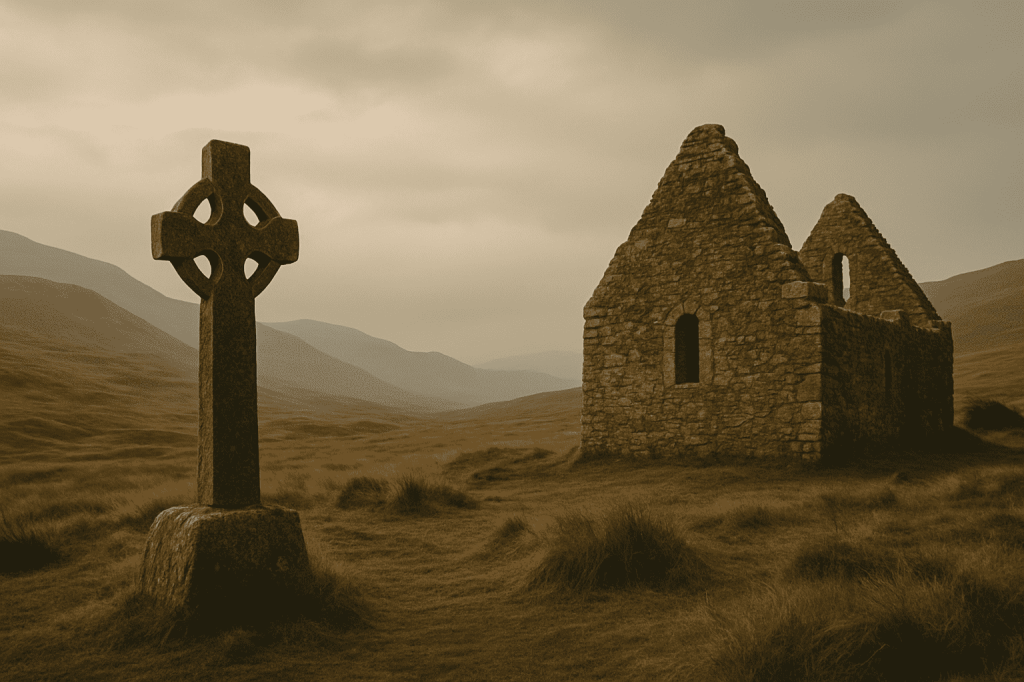
In Celtic lands, the stories were not written in dusty books but sung into the landscape—told by firelight, carved into stones, whispered by streams and trees. The saints did not seek to be remembered. They sought only to walk closely with God.
And because of that, they became unforgettable.
Their legacy is not just in history, but in you.
If your spirit feels weary, remember theirs. If your hands tremble, let them guide you. If your flame flickers, lean close to their fire.
Let their lives not condemn us—but awaken us. Let them not shame us—but remind us of what is possible.

Even now, the call goes out—not just to admire the saints, but to become one.
Not in perfection, but in pursuit. Not in fame, but in faithfulness. Not in greatness, but in grace.
 Ancient Whispers
Leave a comment